
Ocean warming is increasing the frequency, extent, and severity of tropical-coral bleaching and mortality.
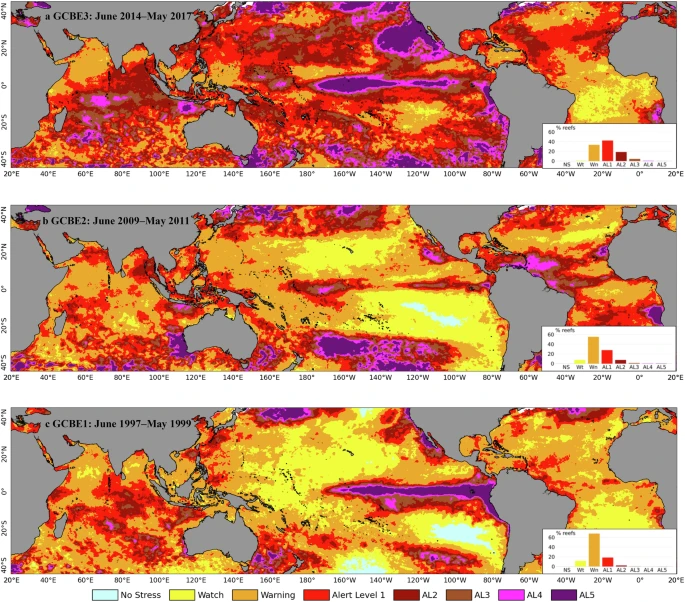
During 2014–2017, marine heatwaves caused the Third Global Coral Bleaching Event. We analyze data from 15,066 reef surveys globally during 2014–2017.
Across all surveyed reefs, 80% and 35% experienced moderate or greater (affecting >10% of corals) bleaching and mortality, respectively.
We assess the global extent of coral bleaching and mortality by applying bleaching response curves calibrated from surveyed reefs to predict bleaching globally, based on comprehensive remote-sensing of heat stress.
These models predict that 51% and 15% of the world’s coral reefs suffered moderate or greater bleaching and mortality, respectively, during one or multiple years, surpassing damage from any prior global coral bleaching event.
Our findings demonstrate that the impacts of ocean warming on coral reefs are accelerating, with the near certainty that ongoing warming will cause large-scale, possibly irreversible, degradation of these essential ecosystems.
With heat stress levels during this event surpassing those observed previously, the National Oceanic and Atmospheric Administration developed more extreme Bleaching Alert levels that are now being used during the ongoing Fourth Global Coral Bleaching Event.
Introduction
Before the 1980s, mass coral bleaching and mortality events due to heat stress were rare1. In the last four decades, these events have become increasingly frequent and severe. Ocean warming is now the foremost threat to coral reefs worldwide2,3,4,5,6,7, and recurrent strong marine heatwaves are causing mass bleaching of corals on regional and global scales2,3,8,9. Coral bleaching occurs when the relationship between corals and their photosynthetic symbionts breaks down10. Bleached corals are physiologically damaged, nutritionally compromised, and may die if the bleaching is severe or prolonged. From June 2014 to May 2017 (hereafter referred to as 2014–17), reefs around the world experienced the third global-scale coral bleaching event11,12,13. This event was, at that time, the most severe global heat stress event recorded on coral reef ecosystems2,8,11,14, surpassing the two prior global coral bleaching events recorded in 199815 and 20103,16. Moreover, 2014–17 was the first record of a global coral bleaching event lasting much beyond a single year2,8,11,14. Specifically, the event spanned 3 years, with bleaching at some locations continuing after the global event concluded17,18,19. Numerous studies have revealed how this event has impacted coral reefs locally at sites around the globe, including the most severe impacts on record in many locations (see20 and references therein).
Here, we analyze the heat stress affecting coral reefs during 2014–17 and the resultant bleaching and mortality to derive statistical relationships between remotely-sensed heat stress and onsite surveys of coral bleaching and mortality at a global scale. We then use these relationships to estimate the global impact of this mass coral bleaching event, accounting for the actual distribution of heat stress across the world’s reef areas. We find substantial variation in the temperature sensitivity of bleaching and survival among years and basins. Overall, we estimate that over half the world’s reefs experienced moderate or greater bleaching, and 15% experienced moderate or greater mortality. The estimated levels of accumulated heat stress, bleaching, and mortality during this event exceeded the severity from all prior global coral bleaching events.
Eakin, C.M., Heron, S.F., Connolly, S.R. et al. Severe and widespread coral reef damage during the 2014-2017 Global Coral Bleaching Event. Nat Commun 17, 1318 (2026). https://doi.org/10.1038/s41467-025-67506-w
Nature Communications volume 17, Article number: 1318 (2026)
You must be logged in to post a comment.