
Sharing some good news and hope from Fiji about our coral reefs.
A new study published in the international journal Coral Reefs shows that coral reefs decimated by a severe Category 5 tropical cyclone in 2016 showed surprising resilience and ability for corals to recover in Fiji.
Our study found Cyclone Winston wiped out more than half of hard coral cover in some areas, but reefs rebounded within 4 years, with coral community composition reassembled to near pre-cyclone levels by 2020, supported by high fish biomass.
Our research adds to a growing body of evidence showing high integrity climate-resilient coral reefs around the world (and especially in Fiji!) can withstand and recover from extreme events – offering hope for the future of coral reefs in a warming climate.
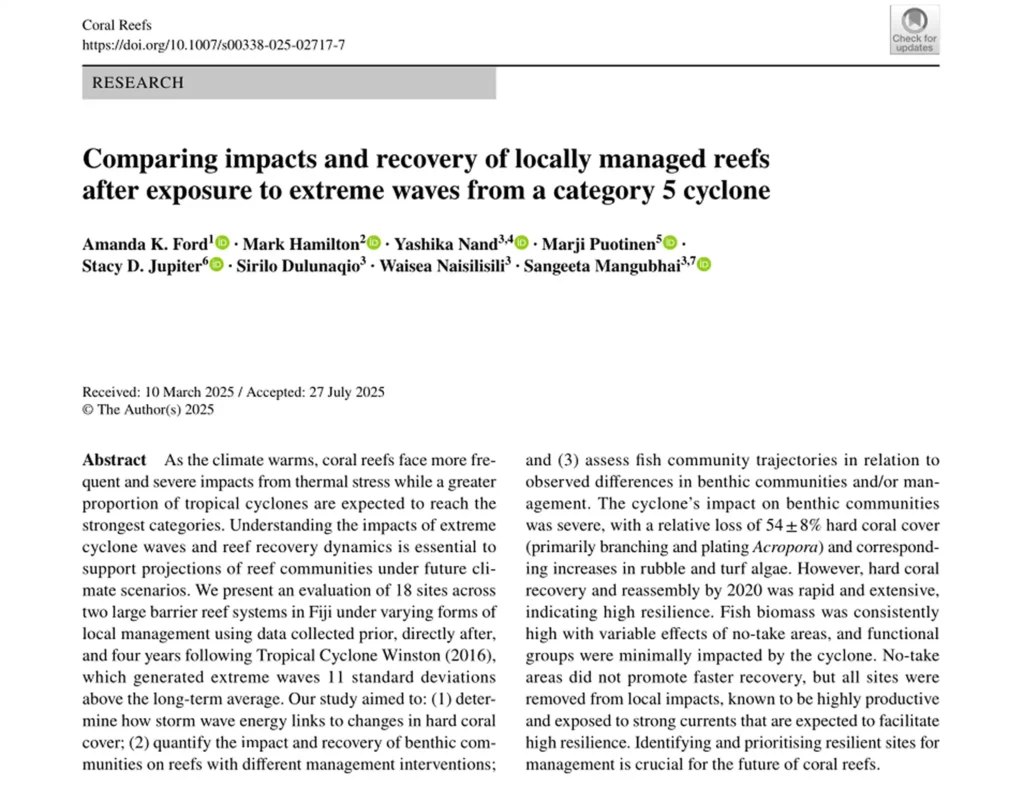
Title: Comparing impacts and recovery of locally managed reefs after exposure to extreme waves from a category 5 cyclone
Authors: Amanda Ford, Mark Hamilton, Yashika Nand, Marji Puotinen, Stacy D. Jupiter, Sirilo Dulunaqio, Waisea Naisilisili, Sangeeta Mangubhai
Abstract: As the climate warms, coral reefs face more frequent and severe impacts from thermal stress while a greater proportion of tropical cyclones are expected to reach the strongest categories.
Understanding the impacts of extreme cyclone waves and reef recovery dynamics is essential to support projections of reef communities under future climate scenarios.
We present an evaluation of 18 sites across two large barrier reef systems in Fiji under varying forms of local management using data collected prior, directly after, and four years following Tropical Cyclone Winston (2016), which generated extreme waves 11 standard deviations above the long-term average.
Our study aimed to: (1) determine how storm wave energy links to changes in hard coral cover; (2) quantify the impact and recovery of benthic communities on reefs with different management interventions; and (3) assess fish community trajectories in relation to observed differences in benthic communities and/or management.
The cyclone’s impact on benthic communities was severe, with a relative loss of 54?±?8% hard coral cover (primarily branching and plating Acropora) and corresponding increases in rubble and turf algae.
However, hard coral recovery and reassembly by 2020 was rapid and extensive, indicating high resilience.
Fish biomass was consistently high with variable effects of no-take areas, and functional groups were minimally impacted by the cyclone.
No-take areas did not promote faster recovery, but all sites were removed from local impacts, known to be highly productive and exposed to strong currents that are expected to facilitate high resilience. Identifying and prioritising resilient sites for management is crucial for the future of coral reefs.
https://link.springer.com/article/10.1007/s00338-025-02717-7
Comparing impacts and recovery of locally managed reefs after exposure to extreme waves from a category 5 cyclone
By Amanda K. Ford, Stacy D. Jupiter, Mark Hamilton, Yashika Nand, Marji Puotinen, Sirilo Dulunaqio, Waisea Naisilisili, & Sangeeta Mangubhai
Originally published in Coral Reefs, October 6, 2025. 1111
Abstract
As the climate warms, coral reefs face more frequent and severe impacts from thermal stress while a greater proportion of tropical cyclones are expected to reach the strongest categories2. Understanding the impacts of extreme cyclone waves and reef recovery dynamics is essential to support projections of reef communities under future climate scenarios3. We present an evaluation of 18 sites across two large barrier reef systems in Fiji under varying forms of local management using data collected prior, directly after, and four years following Tropical Cyclone Winston (2016), which generated extreme waves 11 standard deviations above the long-term average4.
Our study aimed to: (1) determine how storm wave energy links to changes in hard coral cover; (2) quantify the impact and recovery of benthic communities on reefs with different management interventions; and (3) assess fish community trajectories in relation to observed differences in benthic communities and/or management5555. The cyclone’s impact on benthic communities was severe, with a relative loss of hard coral cover (primarily branching and plating Acropora) and corresponding increases in rubble and turf algae666. However, hard coral recovery and reassembly by 2020 was rapid and extensive, indicating high resilience7. Fish biomass was consistently high with variable effects of no-take areas, and functional groups were minimally impacted by the cyclone8. No-take areas did not promote faster recovery, but all sites were removed from local impacts, known to be highly productive and exposed to strong currents that are expected to facilitate high resilience9. Identifying and prioritising resilient sites for management is crucial for the future of coral reefs1010.
Introduction
As the impacts of global change become more pronounced, there is an escalating need to focus on ecosystems at the forefront of these changes11. Coral reefs are high biodiversity systems that provide critical ecosystem services but face mounting pressure from chronic (‘press’) and acute (‘pulse’) disturbances12. Press disturbances often stem from local human activities like overfishing, while pulse disturbances are linked to natural events like cyclones and heat stress, which are worsening with climate change13.
Historically, coral reefs have recovered from sporadic pulse disturbances, but this natural cycle is being altered in the Anthropocene, with more frequent and intense disturbances leaving shorter recovery periods14141414. Cyclones are a common pulse disturbance on tropical reefs, particularly in the Pacific15. While these reefs have evolved with cyclones, future projections of increased intensity are a major concern16161616. Intense cyclones can cause extensive damage, leading to dramatic losses in hard coral cover and reef structure, which can negatively impact fish communities and the livelihoods that depend on them17171717.
The capacity of a reef to recover is influenced by factors like the level of press disturbances and the health of the fish community18. For instance, over-harvesting herbivorous fish can impede recovery by allowing algae to overgrow substrates needed for coral settlement19. To counter these pressures, management interventions like locally managed marine areas (LMMAs) and no-take areas (tabu in Fiji) are used to control extractive pressures20202020.
Using unique data from before, immediately after, and four years following the Category 5 Tropical Cyclone Winston in Fiji, this study aimed to:
- Link storm wave energy to changes in hard coral cover21.
- Quantify cyclone impacts and the recovery of benthic communities under different management interventions22.
- Assess fish community trajectories in relation to changes in the benthic community and/or management23.
Materials and Methods
Study Sites
This study focused on two areas in Fiji’s Bligh Waters: the Nakorotubu District fishing ground (NFG) and the Kubulau District fishing ground (KFG)24. Both are customary fishing grounds (i qoliqoli) and are considered locally managed marine areas25. Within these grounds are two of Fiji’s largest no-take areas: the Vatu-i-Ra Conservation Park (ViRCP) in NFG and the Namena Marine Reserve (NMR) in KFG26. The study surveyed 18 sites across these areas, grouped by management type: KFG (fished), NFG (fished), NMR (no-take), ViRCP_old (no-take since 2012), and ViRCP_new (no-take since 2016)27272727.
Field Surveys
Fish and benthic data were collected along 50 m transects at depths of 4-12 m during four periods: pre-cyclone (2013/2014), post-cyclone (2-3 months after in 2016), and recovery (2018 and 2020)29.
- Benthic data were collected using point-intercept transects, recording the substrate type and coral genus/growth form every 50 cm30.
- Fish data were collected using underwater visual census surveys along a 5m wide belt, recording species and estimating lengths to calculate biomass31.
Wave Exposure Models
Significant wave height (Hs) and duration data were taken from the NOAA WAVEWATCH III global hindcast dataset32. A metric termed ‘WaveDUR’ was calculated by multiplying the relative wave exposure during the cyclone by the number of hours waves were above a damaging threshold ()33. This metric was used to predict reef damage.
Results
Wave Impact and Coral Loss
Cyclone Winston generated extreme waves, with an average significant wave height (Hs) 11 standard deviations above the long-term average34. Maximum Hs reached 12.3 m in the NFG/ViRCP area and 9.4 m in the KFG/NMR area35. The custom metric WaveDUR, which combined wave exposure and duration, was significantly related to both the absolute and relative loss of hard coral cover36. The most exposed sites, C5 and C3 in the KFG area, lost 91% and 88% of their relative hard coral cover, respectively37. Conversely, the least exposed sites (VIR1-3) lost minimal coral coverage38.
Benthic Community Impact and Recovery
Immediately after the cyclone in 2016, there was a significant overall loss of hard coral cover ( relative loss), with a corresponding increase in rubble and turf algae40404040. The greatest coral loss was in the KFG area (
relative loss)41.
By 2020, four years later, all impacted areas showed rapid and extensive recovery42. Hard coral cover increased at an average rate of 2-6.5% annually between 2016 and 202043. The coral community composition also showed strong signs of reassembly, returning to a state similar to its pre-cyclone composition44. The cyclone initially removed fragile, fast-growing branching and plating corals (Acropora), leaving more robust massive and encrusting forms (Porites)45. By 2020, the cover of fast-growing Acropora had recovered and, in some cases, exceeded pre-cyclone levels46.
Fish Community Response
Overall fish biomass remained relatively consistent over time48. However, specific functional groups showed some changes. Corallivore biomass saw the most consistent negative impact immediately after the cyclone, with a 95% decrease in the new ViRCP sites49. Other groups, including herbivores (browser/cropper/grazer) and invertivores, also saw declines in 2016 but recovered50. Marine conservation agreements (no-take areas) had a clear positive impact only on excavator/scraper parrotfish biomass51. Hard coral cover was positively associated with corallivore biomass but negatively associated with detritivore and planktivore biomass52.
Discussion
The reefs in this study demonstrated exceptional recovery and resilience following a severe, category 5 cyclone. Despite an average relative loss of 54% of hard coral cover, the reefs recovered rapidly, with coral communities reassembling to their pre-cyclone state within four years5454545454545454. The annual recovery rate of 2-6.5% matches or exceeds rates reported from other major disturbances globally55.
Several factors likely contributed to this high resilience:
- High Initial Fish Biomass: All study reefs, including fished areas, had healthy fish populations, which is crucial for controlling algae and creating suitable conditions for coral recovery56565656.
- Strong Connectivity: The reefs are located in the path of a major current that can deliver a steady supply of new coral larvae from other healthy reefs57.
- Nutrient Subsidies: The presence of large seabird populations on nearby islands may provide nutrient subsidies (guano) that enhance coral growth rates and reef productivity58.
No-take areas did not appear to promote faster recovery compared to fished areas in this instance59. This may be because the disturbance was so large that it obscured the effects of protection, or because even the fished areas had sufficiently low fishing pressure and high fish biomass to support recovery60606060.
The fish communities remained relatively stable despite the massive benthic habitat destruction61. The decline in corallivores was expected due to the loss of their food source (corals), while other groups like detritivores may have benefited from the increase in dead substrate62626262.
These findings are optimistic, providing rare evidence that some remote, well-connected reefs with healthy fish populations can recover from extreme disturbances63636363. However, this must be interpreted with caution. The increasing frequency of cyclones combined with other stressors like mass bleaching events means the future of coral reefs remains highly concerning64. Our results underscore the importance of managing local stressors (like overfishing) and protecting resilient sites to support the future of coral reefs in a changing climate65656565.
Table 1: Management Characteristics
| Area | Code | Sites | Management Type | Notes |
| Kubulau Fishing Ground | KFG | C3, C5, KB06, KB07 | Within Kubulau District’s customary fishing ground—open to fishing | Open to traditional resource owners for subsistence fishing. Commercial fishing requires a licence. 66 |
| Nakorotubu Fishing Ground | NFG | VIR6, VIR7, VIR10 | Within Nakorotubu District’s customary fishing ground—open to fishing | Open to traditional resource owners for subsistence fishing. Commercial fishing requires a licence. 67 |
| Namena Marine Reserve | NMR | KB04, KB05, N19, N20 | Tabu area | Designated as a tabu area since 1997. Can be opened for short periods when a high chief passes away. 68 |
| Vatu-i-Ra Conservation Park | ViRCP-new | VIR8, VIR9 | Tabu area | Designated as a permanent tabu area in 2016. 69 |
| Vatu-i-Ra Conservation Park | ViRCP-old | VIR1, VIR2, VIR3, VIR4, VIR11 | Tabu area | Designated as a tabu area in 2012 and made a permanent tabu area in 2016. 70 |
References
Anthony, K. R. N., Marshall, P. A., Abdulla, A., Beeden, R., Bergh, C., Black, R., Eakin, C. M., Game, E. T., Gooch, M., Graham, N. A. J., Green, A., Heron, S. F., van Hooidonk, R., Knowland, C., Mangubhai, S., Marshall, N., Maynard, J. A., McGinnity, P., McLeod, E., Mumby, P. J., Nyström, M., Obura, D., Oliver, J., Possingham, H. P., Pressey, R. L., Rowlands, G. P., Tamelander, J., Wachenfeld, D., & Wear, S. (2015). Operationalizing resilience for adaptive coral reef management under global environmental change. Global Change Biology, 21(1), 48–61. https://doi.org/10.1111/gcb.12700
Barto?, K. (2023). MuMIn: Multi-model inference (R Package Version 1.47.5).
Bates, D., Mächler, M., Bolker, B., & Walker, S. (2015). Fitting linear mixed-effects models using lme4. Journal of Statistical Software, 67(1), 1–48. https://doi.org/10.18637/jss.v067.i01
Beeden, R., Maynard, J., Puotinen, M., Marshall, P., Dryden, J., Goldberg, J., & Williams, G. (2015). Impacts and recovery from severe tropical cyclone Yasi on the Great Barrier Reef. PLoS ONE, 10(4), e0121272. https://doi.org/10.1371/journal.pone.0121272
Benkwitt, C. E., Wilson, S. K., & Graham, N. A. J. (2019). Seabird nutrient subsidies alter patterns of algal abundance and fish biomass on coral reefs following a bleaching event. Global Change Biology, 25(8), 2619–2632. https://doi.org/10.1111/gcb.14643
Beyer, H. L., Kennedy, E. V., Beger, M., Chen, C. A., Cinner, J. E., Darling, E. S., Eakin, C. M., Gates, R. D., Heron, S. F., Knowlton, N., Obura, D. O., Palumbi, S. R., Possingham, H. P., Puotinen, M., Runting, R. K., Skirving, W. J., Spalding, M., Wilson, K. A., Wood, S., Veron, J. E., & Hoegh-Guldberg, O. (2018). Risk-sensitive planning for conserving coral reefs under rapid climate change. Conservation Letters, 11(6), e12587. https://doi.org/10.1111/conl.12587
Brandl, S. J., Emslie, M. J., Ceccarelli, D. M., & Richards, Z. T. (2016). Habitat degradation increases functional originality in highly diverse coral reef fish assemblages. Ecosphere, 7(11), e01557. https://doi.org/10.1002/ecs2.1557
Brooks, M. E., Kristensen, K., van Benthem, K. J., Magnusson, A., Berg, C. W., Nielsen, A., Skaug, H. J., Mächler, M., & Bolker, B. M. (2017). glmmTMB balances speed and flexibility among packages for zero-inflated generalized linear mixed modeling. The R Journal, 9(2), 378–400.
Bruno, J. F., Côté, I. M., & Toth, L. T. (2019). Climate change, coral loss, and the curious case of the parrotfish paradigm: Why don’t marine protected areas improve reef resilience? Annual Review of Marine Science, 11, 307–334. https://doi.org/10.1146/annurev-marine-010318-095300
Ceccarelli, D. M., Emslie, M. J., Logan, M., Cole, A., Blandford, M. I., & Sinclair-Taylor, T. H. (2025). Patterns in the chaos: Scale and the spatiotemporal dynamics of coral reef fish assemblages on the Great Barrier Reef. Ecosphere, 16(5), e70227. https://doi.org/10.1002/ecs2.70227
Chand, S. S., & Walsh, K. J. E. (2009). Tropical cyclone activity in the Fiji region: Spatial patterns and relationship to large-scale circulation. Journal of Climate, 22(14), 3877–3893. https://doi.org/10.1175/2009JCLI2880.1
Chand, S. S., Walsh, K. J. E., Camargo, S. J., Kossin, J. P., Tory, K. J., Wehner, M. F., Chan, J. C. L., Klotzbach, P. J., Dowdy, A. J., Bell, S. S., & Ramsay, H. A. (2022). Declining tropical cyclone frequency under global warming. Nature Climate Change, 12(7), 655–661. https://doi.org/10.1038/s41558-022-01388-4
Cheal, A. J., MacNeil, M. A., Emslie, M. J., & Sweatman, H. (2017). The threat to coral reefs from more intense cyclones under climate change. Global Change Biology, 23(4), 1511–1524. https://doi.org/10.1111/gcb.13593
Cinner, J. E., Marnane, M. J., McClanahan, T. R., & Almany, G. R. (2006). Periodic closures as adaptive coral reef management in the Indo-Pacific. Ecology and Society, 11(1), 31.
Clarke, P., & Jupiter, S. D. (2010). Law, custom and community-based natural resource management in Kubulau District (Fiji). Environmental Conservation, 37(1), 98–106. https://doi.org/10.1017/S0376892910000354
Connell, J. H. (1997). Disturbance and recovery of coral assemblages. Coral Reefs, 16(S1), S101–S113. https://doi.org/10.1007/s003380050246
Craig, P., DiDonato, G., Fenner, D., & Hawkins, C. (2005). The state of coral reef ecosystems of American Samoa. In J. Waddell (Ed.), The state of coral reef ecosystems of the United States and Pacific Freely Associated States: 2005 (pp. 312-337). NOAA Technical Memorandum NOS NCCOS 11.
Darling, E. S., Alvarez-Filip, L., Oliver, T. A., McClanahan, T. R., & Côté, I. M. (2012). Evaluating life-history strategies of reef corals from species traits. Ecology Letters, 15(12), 1378–1386. https://doi.org/10.1111/j.1461-0248.2012.01861.x
Darling, E. S., McClanahan, T. R., Maina, J., Gurney, G. G., Graham, N. A. J., Januchowski-Hartley, F., … & Bruno, J. F. (2019). Social-environmental drivers inform strategic management of coral reefs in the Anthropocene. Nature Ecology & Evolution, 3(9), 1341–1350. https://doi.org/10.1038/s41559-019-0953-8
Dixon, A. M., Puotinen, M., Ramsay, H. A., & Beger, M. (2022). Coral reef exposure to damaging tropical cyclone waves in a warming climate. Earth’s Future, 10(3), e2021EF002600. https://doi.org/10.1029/2021EF002600
Doropoulos, C., Ward, S., Roff, G., González-Rivero, M., & Mumby, P. J. (2015). Linking demographic processes of juvenile corals to benthic recovery trajectories in two common reef habitats. PLoS ONE, 10(5), e0128535. https://doi.org/10.1371/journal.pone.0128535
Drew, J. A., & Barber, P. H. (2012). Comparative phylogeography in Fijian coral reef fishes: a multi-taxa approach towards marine reserve design. PLoS ONE, 7(10), e47710. https://doi.org/10.1371/journal.pone.0047710
Eakin, C. M., Sweatman, H. P. A., & Brainard, R. E. (2019). The 2014–2017 global-scale coral bleaching event: Insights and impacts. Coral Reefs, 38(4), 539–545. https://doi.org/10.1007/s00338-019-01844-2
Ellis, J. I., Jamil, T., Anlauf, H., Coker, D. J., Curdia, J., Hewitt, J., … & Hoteit, I. (2019). Multiple stressor effects on coral reef ecosystems. Global Change Biology, 25(12), 4131–4146. https://doi.org/10.1111/gcb.14819
Emslie, M. J., Logan, M., Bray, P., Ceccarelli, D. M., Cheal, A. J., Hughes, T. P., … & Sweatman, H. (2024). Increasing disturbance frequency undermines coral reef recovery. Ecological Monographs, 94(3), e1619. https://doi.org/10.1002/ecm.1619
Foale, S., Cohen, P., Januchowski-Hartley, S., Wenger, A., & Macintyre, M. (2011). Tenure and taboos: Origins and implications for fisheries in the Pacific. Fish and Fisheries, 12(4), 357–369. https://doi.org/10.1111/j.1467-2979.2010.00395.x
Ford, A. K., Eich, A., McAndrews, R. S., & Mangubhai, S. (2018). Evaluation of coral reef management effectiveness using conventional versus resilience-based metrics. Ecological Indicators, 85, 308–317. https://doi.org/10.1016/j.ecolind.2017.10.002
Ford, A. K., Jouffray, J. B., & Norström, A. V. (2020). Local human impacts disrupt relationships between benthic reef assemblages and environmental predictors. Frontiers in Marine Science, 7, 571115. https://doi.org/10.3389/fmars.2020.571115
Ford, A. K., Visser, P. M., van Herk, M. J., Jongepier, E., & Bonito, V. (2021). First insights into the impacts of benthic cyanobacterial mats on fish herbivory functions on a nearshore coral reef. Scientific Reports, 11(1), 7147. https://doi.org/10.1038/s41598-021-84016-z
Froese, R., & Pauly, D. (Eds.). (2023). FishBase. World Wide Web electronic publication. www.fishbase.org
Gilmour, J. P., Cook, K. L., Ryan, N. M., Puotinen, M. L., Green, R. H., & Heyward, A. J. (2022). A tale of two reef systems: Local conditions, disturbances, coral life histories, and the climate catastrophe. Ecological Applications, 32(2), e2509. https://doi.org/10.1002/eap.2509
Goatley, C. H., Bonaldo, R. M., Fox, R. J., & Bellwood, D. R. (2016). Sediments and herbivory as sensitive indicators of coral reef degradation. Ecology and Society, 21(1), 29. https://doi.org/10.5751/ES-08334-210129
Goetze, J. S., & Fullwood, L. A. F. (2013). Fiji’s largest marine reserve benefits reef sharks. Coral Reefs, 32(1), 121–125. https://doi.org/10.1007/s00338-012-0970-4
Govan, H., & Jupiter, S. (2013). Can the IUCN 2008 protected areas management categories support Pacific island approaches to conservation? Parks, 19(2), 73–80.
Graham, N. A. J., Nash, K. L., & Kool, J. T. (2011). Coral reef recovery dynamics in a changing world. Coral Reefs, 30(2), 283–294. https://doi.org/10.1007/s00338-010-0717-z
Hall, A. E., & Kingsford, M. J. (2021). Habitat type and complexity drive fish assemblages in a tropical seascape. Journal of Fish Biology, 99(4), 1364–1379. https://doi.org/10.1111/jfb.14843
Harmelin-Vivien, M. L., & Laboute, P. (1986). Catastrophic impact of hurricanes on atoll outer reef slopes in the Tuamotu (French Polynesia). Coral Reefs, 5(2), 55–62. https://doi.org/10.1007/BF00270353
Hartig, F. (2024). DHARMa: Residual Diagnostics for Hierarchical (Multi-Level/Mixed) Regression Models (R package version 0.4.7). https://github.com/florianhartig/dharma
Hill, J., & Wilkinson, C. (2004). Methods for ecological monitoring of coral reefs: A resource for managers. Australian Institute of Marine Science.
Hughes, T. P., Baird, A. H., Bellwood, D. R., Card, M., Connolly, S. R., Folke, C., … & Roughgarden, J. (2003). Climate change, human impacts, and the resilience of coral reefs. Science, 301(5635), 929–933. https://doi.org/10.1126/science.1085046
Hughes, T. P., Bellwood, D. R., Folke, C., McCook, L. J., & Pandolfi, J. M. (2007a). No-take areas, herbivory and coral reef resilience. Trends in Ecology & Evolution, 22(1), 1–3. https://doi.org/10.1016/j.tree.2006.10.009
Hughes, T. P., Rodrigues, M. J., Bellwood, D. R., Ceccarelli, D., Hoegh-Guldberg, O., McCook, L., … & Willis, B. (2007b). Phase shifts, herbivory, and the resilience of coral reefs to climate change. Current Biology, 17(4), 360–365. https://doi.org/10.1016/j.cub.2006.12.049
Hughes, T. P., Anderson, K. D., Connolly, S. R., Heron, S. F., Kerry, J. T., Lough, J. M., & Wilson, S. K. (2018). Spatial and temporal patterns of mass bleaching of corals in the Anthropocene. Science, 359(6371), 80–83. https://doi.org/10.1126/science.aan8048
IPCC. (2019). Summary for Policymakers. In H.-O. Pörtner, D. C. Roberts, V. Masson-Delmotte, P. Zhai, M. Tignor, E. Poloczanska, K. Mintenbeck, A. Alegría, M. Nicolai, A. Okem, J. Petzold, B. Rama, & N. M. Weyer (Eds.), IPCC Special Report on the Ocean and Cryosphere in a Changing Climate (pp. 3–35). Cambridge University Press.
Johns, K. A., Emslie, M. J., Hoey, A. S., Osborne, K., Jonker, M. J., & Cheal, A. J. (2018). Macroalgal feedbacks and substrate properties maintain a coral reef regime shift. Ecosphere, 9(8), e02349. https://doi.org/10.1002/ecs2.2349
Jupiter, S. D., & Egli, D. P. (2011). Ecosystem-based management in Fiji: Successes and challenges after five years of implementation. Journal of Marine Science, 2011, 940765. https://doi.org/10.1155/2011/940765
Jupiter, S. D., Cohen, P. J., Weeks, R., Tawake, A., & Govan, H. (2014). Locally-managed marine areas: Multiple objectives and diverse strategies. Pacific Conservation Biology, 20(2), 165–179.
Kenyon, T. M., Doropoulos, C., Wolfe, K., Webb, G. E., Dove, S., Harris, D., & Mumby, P. J. (2023). Coral rubble dynamics in the Anthropocene and implications for reef recovery. Limnology and Oceanography, 68(1), 110–147. https://doi.org/10.1002/lno.12254
Koester, A., Migani, V., Bunbury, N., Ford, A., Sanchez, C., & Wild, C. (2020). Early trajectories of benthic coral reef communities following the 2015/16 coral bleaching event at remote Aldabra Atoll, Seychelles. Scientific Reports, 10(1), 17034. https://doi.org/10.1038/s41598-020-74077-x
Linares, C., Pratchett, M. S., & Coker, D. J. (2011). Recolonisation of Acropora hyacinthus following climate-induced coral bleaching on the Great Barrier Reef. Marine Ecology Progress Series, 438, 97–104. https://doi.org/10.3354/meps09272
Lovell, E., Sykes, H., Deiye, M., Wantiez, L., Garrigue, C., Virly, S., … & Pakoa, K. (2004). Status of coral reefs in the South West Pacific: Fiji, Nauru, New Caledonia, Samoa, Solomon Islands, Tuvalu and Vanuatu. In Status of Coral Reefs of the World: 2004 (Vol. 2, pp. 337-362).
Lüdecke, D. (2018). sjPlot: Data Visualization for Statistics in Social Science (R package version 2.8.17). https://CRAN.R-project.org/package=sjPlot
MacNeil, M. A., Graham, N. A. J., Cinner, J. E., Wilson, S. K., Williams, I. D., Maina, J., … & McClanahan, T. R. (2015). Recovery potential of the world’s coral reef fishes. Nature, 520(7547), 341–344. https://doi.org/10.1038/nature14358
MacNeil, M. A., Mellin, C., Matthews, S., Wolff, N. H., McClanahan, T. R., Devlin, M., … & Graham, N. A. J. (2019). Water quality mediates resilience on the Great Barrier Reef. Nature Ecology & Evolution, 3(4), 620–627. https://doi.org/10.1038/s41559-019-0832-3
Malhi, Y., Franklin, J., Seddon, N., Solan, M., Turner, M. G., Field, C. B., & Knowlton, N. (2020). Climate change and ecosystems: Threats, opportunities and solutions. Philosophical Transactions of the Royal Society B, 375(1794), 20190104. https://doi.org/10.1098/rstb.2019.0104
Mangubhai, S. (2016). Impact of Tropical Cyclone Winston on Coral Reefs in the Vatu-i-Ra Seascape (Report No. 01/16). Wildlife Conservation Society.
Mangubhai, S., Sykes, H., Lovell, E., Brodie, G., Jupiter, S., Morris, C., … & Qauqau, I. (2019). Chapter 35 – Fiji: Coastal and Marine Ecosystems. In C. Sheppard (Ed.), World Seas: An Environmental Evaluation (Second Edition) (pp. 765–792). Academic Press.
Mangubhai, S., Sykes, H., Manley, M., Vukikomoala, K., & Beattie, M. (2020). Contributions of tourism-based marine conservation agreements to natural resource management in Fiji. Ecological Economics, 171, 106607. https://doi.org/10.1016/j.ecolecon.2020.106607
Marler, T. E. (2014). Pacific Island tropical cyclones are more frequent and globally relevant, yet less studied. Frontiers in Environmental Science, 2, 42. https://doi.org/10.3389/fenvs.2014.00042
McClanahan, T. R. (2021). Marine reserve more sustainable than gear restriction in maintaining long-term coral reef fisheries yields. Marine Policy, 128, 104478. https://doi.org/10.1016/j.marpol.2021.104478
McClanahan, T. R., Graham, N. A. J., MacNeil, M. A., Muthiga, N. A., Cinner, J. E., Bruggemann, J. H., & Wilson, S. K. (2011). Critical thresholds and tangible targets for ecosystem-based management of coral reef fisheries. Proceedings of the National Academy of Sciences, 108(41), 17230–17233. https://doi.org/10.1073/pnas.1106861108
McClanahan, T. R., Donner, S. D., Maynard, J. A., MacNeil, M. A., Graham, N. A. J., Maina, J., … & van Woesik, R. (2012). Prioritizing key resilience indicators to support coral reef management in a changing climate. PLoS ONE, 7(8), e42884. https://doi.org/10.1371/journal.pone.0042884
McClanahan, T. R., Darling, E. S., Beger, M., Fox, H. E., Grantham, H. S., Jupiter, S. D., … & Maina, J. M. (2024). Diversification of refugia types needed to secure the future of coral reefs subject to climate change. Conservation Biology, 38(1), e14108. https://doi.org/10.1111/cobi.14108
McLean, M., Cuetos-Bueno, J., Nedlic, O., Luckymiss, M., & Houk, P. (2016). Local stressors, resilience, and shifting baselines on coral reefs. PLoS ONE, 11(11), e0166319. https://doi.org/10.1371/journal.pone.0166319
Mills, M., Jupiter, S. D., Pressey, R. L., Ban, N. C., & Comley, J. (2011). Incorporating effectiveness of community-based management in a national marine gap analysis for Fiji. Conservation Biology, 25(6), 1155–1164. https://doi.org/10.1111/j.1523-1739.2011.01749.x
Mumby, P. J., Bejarano, S., Golbuu, Y., Steneck, R. S., Arnold, S. N., van Woesik, R., & Friedlander, A. M. (2013). Empirical relationships among resilience indicators on Micronesian reefs. Coral Reefs, 32(2), 213–226. https://doi.org/10.1007/s00338-012-0966-0
Mumby, P. J., Wolff, N. H., Bozec, Y. M., Chollett, I., & Halloran, P. (2014). Operationalizing the resilience of coral reefs in an era of climate change. Conservation Letters, 7(3), 176–187. https://doi.org/10.1111/conl.12047
Neary, V. S., & Ahn, S. (2023). Global atlas of extreme significant wave heights and relative risk ratios. Renewable Energy, 208, 130–140. https://doi.org/10.1016/j.renene.2023.03.079
Nyström, M., Folke, C., & Moberg, F. (2000). Coral reef disturbance and resilience in a human-dominated environment. Trends in Ecology & Evolution, 15(10), 413–417. https://doi.org/10.1016/S0169-5347(00)01948-0
Nyström, M., Graham, N. A. J., Lokrantz, J., & Norström, A. V. (2008). Capturing the cornerstones of coral reef resilience: Linking theory to practice. Coral Reefs, 27(4), 795–809. https://doi.org/10.1007/s00338-008-0426-z
Pauly, D., & Froese, R. (2006). The length-weight relationship of fishes: a review. Journal of Applied Ichthyology, 22(4), 241–253.
Price, B. A., Harvey, E. S., Mangubhai, S., Saunders, B. J., Puotinen, M., & Goetze, J. S. (2021). Responses of benthic habitat and fish to severe tropical cyclone Winston in Fiji. Coral Reefs, 40(3), 807–819. https://doi.org/10.1007/s00338-021-02086-x
Puotinen, M. L. (2005). A fully automated method for measuring fetch in complex reef island systems: Case study of the central GBR. MODSIM 2005 International Congress on Modelling and Simulation.
Puotinen, M., Maynard, J. A., Beeden, R., Radford, B., & Williams, G. J. (2016). A robust operational model for predicting where tropical cyclone waves damage coral reefs. Scientific Reports, 6(1), 26009. https://doi.org/10.1038/srep26009
Puotinen, M., Drost, E., Lowe, R., Depczynski, M., Radford, B., Heyward, A., & Gilmour, J. (2020). Towards modelling the future risk of cyclone wave damage to the world’s coral reefs. Global Change Biology, 26(8), 4302–4315. https://doi.org/10.1111/gcb.15136
R Core Team. (2023). R: A Language and Environment for Statistical Computing. R Foundation for Statistical Computing. https://www.R-project.org/
Robinson, J. P. W., Williams, I. D., Yeager, L. A., McPherson, J. M., Clark, J., Oliver, T. A., & Baum, J. K. (2018). Environmental conditions and herbivore biomass determine coral reef benthic community composition: Implications for quantitative baselines. Coral Reefs, 37(4), 1157–1168. https://doi.org/10.1007/s00338-018-01737-w
Russ, G. R., & McCook, L. J. (1999). Potential effects of a cyclone on benthic algal production and yield to grazers on coral reefs across the central Great Barrier Reef. Journal of Experimental Marine Biology and Ecology, 235(2), 237–254. https://doi.org/10.1016/S0022-0981(98)00180-4
Russ, G. R., Questel, S. L. A., Rizzari, J. R., & Alcala, A. C. (2015). The parrotfish–coral relationship: Refuting the ubiquity of a prevailing paradigm. Marine Biology, 162(10), 2029–2045. https://doi.org/10.1007/s00227-015-2728-3
Russ, G. R., Payne, C. S., Bergseth, B. J., Rizzari, J. R., Abesamis, R. A., & Alcala, A. C. (2018). Decadal?scale response of detritivorous surgeonfishes (family Acanthuridae) to no?take marine reserve protection and changes in benthic habitat. Journal of Fish Biology, 93(5), 887–900. https://doi.org/10.1111/jfb.13809
Savage, C. (2019). Seabird nutrients are assimilated by corals and enhance coral growth rates. Scientific Reports, 9(1), 4284. https://doi.org/10.1038/s41598-019-41030-6
Smith, J. E., Brainard, R., Carter, A., Grillo, S., Edwards, C., Harris, J., … & Sandin, S. (2016). Re-evaluating the health of coral reef communities: Baselines and evidence for human impacts across the central Pacific. Proceedings of the Royal Society B: Biological Sciences, 283(1822), 20151985. https://doi.org/10.1098/rspb.2015.1985
Speare, K. E., Duran, A., Miller, M. W., & Burkepile, D. E. (2019). Sediment associated with algal turfs inhibits the settlement of two endangered coral species. Marine Pollution Bulletin, 144, 189–195. https://doi.org/10.1016/j.marpolbul.2019.04.066
Stimson, J. (1985). The effect of shading by the table coral Acropora hyacinthus on understory corals. Ecology, 66(1), 40–53.
Sully, S., Burkepile, D. E., Donovan, M. K., Hodgson, G., & van Woesik, R. (2019). A global analysis of coral bleaching over the past two decades. Nature Communications, 10(1), 1264. https://doi.org/10.1038/s41467-019-09238-2
Swierts, T., & Vermeij, M. J. (2016). Competitive interactions between corals and turf algae depend on coral colony form. PeerJ, 4, e1984. https://doi.org/10.7717/peerj.1984
Tarburton, M. K. (1978). Some recent observations on seabirds breeding in Fiji. Notornis, 25(4), 303–316.
Thomas, A. S., Mangubhai, S., Radway, K. C., Fox, M., Jupiter, S. D., Lalavanua, W., … & Rabukawaqa, A. (2025). Impact of severe tropical cyclone Winston on fisheries-dependent communities in Fiji. Environmental Development, 54, 101137. https://doi.org/10.1016/j.envdev.2025.101137
Tolman, H. L. (2009). User manual and system documentation of WAVEWATCH III version 3.14. NOAA/NWS/NCEP/MMAB Technical Note 276.
Vercelloni, J., Liquet, B., Kennedy, E. V., González-Rivero, M., Caley, M. J., Peterson, E. E., … & Mengersen, K. (2020). Forecasting intensifying disturbance effects on coral reefs. Global Change Biology, 26(5), 2785–2797. https://doi.org/10.1111/gcb.15059
Vu, V. Q. (2011). ggbiplot: A ggplot2-based biplot. GitHub repository.
Walker, A. S., Kratochwill, C. A., & van Woesik, R. (2024). Past disturbances and local conditions influence the recovery rates of coral reefs. Global Change Biology, 30(1), e17112. https://doi.org/10.1111/gcb.17112
Walther, G. R., Post, E., Convey, P., Menzel, A., Parmesan, C., Beebee, T. J. C., … & Bairlein, F. (2002). Ecological responses to recent climate change. Nature, 416(6879), 389–395. https://doi.org/10.1038/416389a
Wantiez, L., Chateau, O., & Le Mouellic, S. (2006). Initial and mid-term impacts of cyclone Erica on coral reef fish communities and habitat in the South Lagoon Marine Park of New Caledonia. Journal of the Marine Biological Association of the United Kingdom, 86(5), 1229–1236. https://doi.org/10.1017/S0025315406014238
WCS. (2009). Ecosystem-Based Management Plan: Kubulau District, Vanua Levu. Wildlife Conservation Society.
WCS. (2010). WCS-Fiji marine biological handbook (Version 3.0). Wildlife Conservation Society Fiji.
WCS. (2018). Vatu-i-Ra Conservation Park Management Plan. Wildlife Conservation Society.
Webster, F. J., Babcock, R. C., Van Keulen, M., & Loneragan, N. R. (2015). Macroalgae inhibits larval settlement and increases recruit mortality at Ningaloo Reef, Western Australia. PLoS ONE, 10(4), e0124162. https://doi.org/10.1371/journal.pone.0124162
Wilson, S. K., Graham, N. A. J., Pratchett, M. S., Jones, G. P., & Polunin, N. V. C. (2006). Multiple disturbances and the global degradation of coral reefs: Are reef fishes at risk or resilient? Global Change Biology, 12(11), 2220–2234. https://doi.org/10.1111/j.1365-2486.2006.01252.x
Wood, S., & Scheipl, F. (2020). Generalized Additive Mixed Models using “mgcv” and “lme4” (R package version 0.2-6). https://CRAN.R-project.org/package=gamm4
Wu, L., Zhao, H., Wang, C., Cao, J., & Liang, J. (2022). Understanding of the effect of climate change on tropical cyclone intensity: A review. Advances in Atmospheric Sciences, 39(2), 205–221. https://doi.org/10.1007/s00376-021-1026-x
You must be logged in to post a comment.