
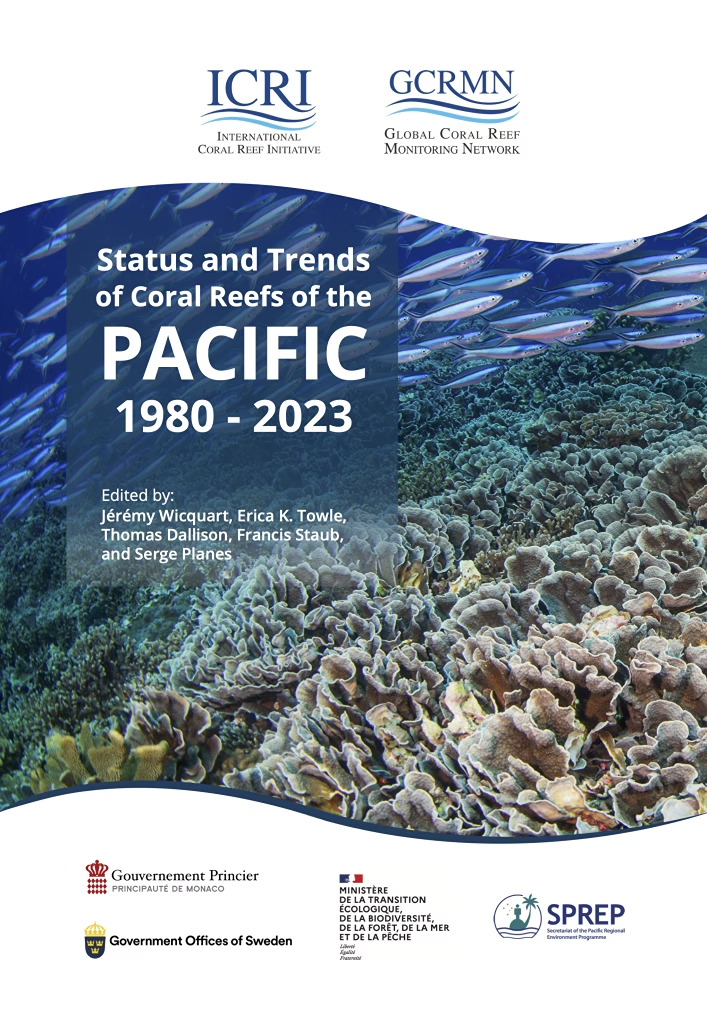
Global Coral Reef Monitoring Network (GCRMN) and International Coral Reef Initiative (ICRI) – Status and Trends of Coral Reefs of the Pacific: 1980–2023
Fiji Co-authors: Sangeeta Mangubhai, Amanda Ford, Mike Neuman, Helen Sykes, Alexandra C. Dempsey, Yashika Nand, Jan Freiwald, Jenny Mihaly
Key Points
- Coral reefs of the GCRMN Pacific region cover 65,255 km² which represent 26.13% of the world’s coral reef extent.
- Overall, hard coral cover remained relatively stable at around 25.5% from 1990 to 2022. • However, hard coral cover declined in 1998 (-2.4%) and again in 2014-2017 (-3.7%) due to global coral bleaching events induced by marine heatwaves.
- Macroalgae cover and coralline algae cover increased by 2.7% and 1.9%, respectively, from 1990 to 2022.
- The number of people living within 5 km from coral reefs increased by 28.7% from 2000 to 2020 at the regional scale.
- Mean sea surface temperature over coral reef areas across the Pacific increased by +0.82°C between 1985 and 2023, driven by climate change, representing a warming rate of 0.22°C per decade.
- Coral reef monitoring efforts varied between countries and territories within the region, ranging from 0 monitoring sites in Nauru to over 2,000 in Hawai’i, underscoring the need to strengthen and expand monitoring initiatives throughout the Pacific.
Fiji Chapter
Fiji Co-authors: Sangeeta Mangubhai, Amanda Ford, Mike Neuman, Helen Sykes, Alexandra C. Dempsey, Yashika Nand, Jan Freiwald, Jenny Mihaly
Reference
Wicquart J., Towle E. K., Dallison T., Staub F., and Planes S. (eds.), 2025. Status and Trends of Coral Reefs of the Pacific: 1980-2023. Global Coral Reef Monitoring Network (GCRMN) and International Coral Reef Initiative (ICRI). doi.org/10.59387/WIUJ2936
Acknowledgments
The publication of this report would not have been possible without the encouragement and financial support provided by the French Ministry for Ecological Transition, the Gouvernement Princier – Principauté de Monaco, the Government Offices of Sweden, and the Bloomberg Ocean Initiative. We sincerely thank them for their invaluable contribution.
We would like to give our acknowledgements to the Australian Institute of Marine Science (AIMS) as the host of the Global Coral Reef Monitoring Network (GCRMN). We also acknowledge the guidance and support from the International Coral Reef Initiative (ICRI) Secretariat, and the US Department of State, and the National Oceanic and Atmospheric Administration (NOAA) as the 2021-2024 ICRI co-chairs.
We further thank the Secretariat of the Pacific Regional Environment Programme (SPREP) for their continued support to the GCRMN Pacific regional node, the production of this report and continued advocacy for the conservation of coral reefs in the Pacific.
The coordination of this report would not have been possible without the support from MAREPOLIS and Blue Pangolin Consulting Ltd. And we extend our gratitude to the supporting agencies, organisations and programmes who have enabled the production of this report.
The production of this report benefited greatly from the organisation of a workshop held in Auckland, New Zealand (November 2023) and we sincerely thank James Nikitine and Gabriella Wina from the Blue Cradle foundation, and Anne Tessier, for their invaluable contributions to the organization of this event.
This report would not have been possible without the dedicated efforts of all those who collected data on benthic cover in coral reefs of the Pacific over the last decades. We extend our deepest gratitude to them for generously sharing their data, which was instrumental in the production of this report. Their contributions are recognized in the following paragraphs or in the “Authors’ Contributions” section.
We thank the Reef Check Foundation, and its volunteers who have spent countless hours collecting these data.
We thank the Service National d’Observation CORAIL from CRIOBE who kindly provided data.
We thank the National Park Service, Pacific Island Network Inventory and Monitoring Program, for sharing their benthic marine database. Funding for the collection of these data was provided by the National Park Service Inventory and Monitoring Program.
We gratefully acknowledge the Ministries of Fisheries and Environment of the Government of Tonga, the Waitt Institute, the 100 Island Challenge, Scripps Institution of Oceanography, and the Vava’u Environmental Protection Association for generously providing coral reef monitoring data from Tonga.
We thank C2O (Coasts, Climate, Oceans) Pacific for providing coral reef monitoring data, made possible through the support of the TasiVanua and Nguna-Pele Resource Networks, the Vanuatu Fisheries Department, and the Vanuatu Department of Environment, and funding from the PEBACC project (SPREP) and RESCCUE project (SPC).
This publication makes use of data products provided by the Micronesia Coral Reef Monitoring Program, the Marshall Islands Marine Resources Authority, the Marshall Islands Conservation Society, and the College of the Marshall Islands. The data analysis and interpretations presented in this report are solely that of the current authors.
We thank the Wildlife Conservation Society (WCS) and particularly Emily Darling, Kim Fisher, Sharla Gelfand and Amkieltiela for the development of the MERMAID platform and their help with the use of the associated mermaidr R package.
We thank the ReefCloud team for their help on contacting project administrators within this platform, notably Samuel Chan and Manuel Gonzalez Rivero.
We are grateful to Murray Logan for his valuable guidance on machine learning models and for generously sharing an R script for visualizing grey ribbons on modeled temporal trends. We also extend our thanks to Jacqueline De La Cour, Gang Liu, Erick Geiger, and Liam Lachs for their insightful advice on the CoralTemp dataset.
You must be logged in to post a comment.