
Executive Summary
Background, purpose and methodology
In 2005, the government of Fiji committed to protecting at least 30% of Fiji’s marine areas using ‘comprehensive, ecologically representative networks of MPAs [marine protected areas], which are effectively managed and financed’.
In order to establish a comprehensive and ecologically representative network of marine protected areas (MPAs), Fiji must first have in place a suitable legal framework, that is, appropriate policies and legislation.
The purpose of this paper is to support the development of a comprehensive legal framework for the establishment and management of an effective network of MPAs in Fiji which is based on science and suited to the Fiji context.
MPAs are not just aimed at limiting fishing activity but also promote a whole range of potential uses that address critical issues such as: food security, resilience to natural disasters and adaptation to climate change.
To create a network of MPAs suited to the Fiji context is a significant challenge that will not be achieved through law reform alone, as it requires a multi-disciplinary approach and involves consultation and agreement with communities, the Ministry of Fisheries, NGOs, fisheries experts, economists and lawyers, amongst others.
It is also crucial to understand, respect, and work within, Fiji’s unique law and governance context that includes the recognition of traditional rights, communities and artisanal fishers.
Ultimately, as decisions to create MPAs will affect existing user rights, they can only be developed through a consultative process that takes into account the views and concerns of those who will be affected.
With these contextual issues in mind, in order to support the development of a comprehensive legal framework for the establishment and management of an effective network of MPAs in Fiji, this paper:
- outlines the law and governance context and the existing MPA mechanisms in Fiji (Parts 1, 2, and 3);
- identifies 27 key recommendations that an MPA legal framework should address (IUCN-based Recommendations) based on the 2011 Guidelines for Protected Areas Legislation published by the International Union for the Conservation of Nature4(2011 IUCN Guidelines) (Part 4);
- assesses the adequacy of Fiji’s existing MPA mechanisms by reference to the IUCN based Recommendations (Part 5);
- identifies options for law reform and some possible next steps in this process (Parts 6 and 7).
In summary, Fiji’s existing MPA mechanisms can be identified as follows (Existing MPA Mechanisms):
- ‘Informal’ MPAs: customary tabus and locally managed marine areas (LMMAs); ? the regulation making powers under the Fisheries Act 1942 (Fisheries Act) which have enabled the creation of site-specific MPAs;
- the power to designate MPAs and related regulation making powers under the Offshore Fisheries Management Decree 2012 (Offshore Decree);
- the licensing of foreshore land under the State Lands Act 1946 (SLA)5; and ? the relevant provisions of the Environment Management Act 2005 (EMA), in particular, the environmental impact assessment (EIA) processes and the provisions relating to the National Environment Council (NEC) which has established the Protected Areas Committee (PAC).
Key findings
The analysis undertaken in this paper reveals that whilst the Existing MPA Mechanisms have some notable strengths, they are deficient in a number of respects and do not adequately form a comprehensive legal framework for establishing and managing MPAs. The key strengths and weaknesses of the Existing MPA Mechanisms are summarised below. Appendix B outlines the strengths and weaknesses of the Existing MPA Mechanisms in relation to each of the 27 IUCN-based Recommendations.
Strengths of the Existing MPA Mechanisms
The key strengths of the Existing MPA Mechanisms include:
- Customary tabus: A key strength of customary tabus is their flexibility. Tabus can be imposed (or revoked) by chiefly decision.
- LMMAs: LMMAs go some way to bridging the gap between customary and ‘modern’ law as they, among other things, combine traditional knowledge and practices with modern scientific and technical expertise in MPA management.6
- The Offshore Decree: Although not designed or ideally suited to regulating inshore marine areas, in particular iQoliqoli, the Offshore Decree has a number of important strengths, including relatively strong ‘objective’ and ‘principles and measures’ clauses and the powers to establish advisory committees.7
- The SLA MPA mechanisms: Strengths of the SLA mechanisms include the conferral of a statutory right on the Customary Fishing Rights Owners (CFROs) as lessee or licensee where SLA leases or licenses are granted, public notification and consultation requirements prior to the grant of a foreshore lease, and the practice of compensating CFROs for the loss of customary fishing rights when foreshore leases and licences are granted.8It should be noted however that the SLA was not designed as an instrument for establishing MPAs. There are significant difficulties with seeking to use the SLA for this purpose, including that it is unclear as to whether the Department of Lands (DoL) has the jurisdiction or authority to regulate activities in waters and marine resources above foreshore land and above the seabed beyond the foreshore. For these reasons, SLA leases and licences are not considered in this paper as offering a viable means of establishing MPAs. Nevertheless, as noted here, the SLA mechanisms do demonstrate some strengths which may form the basis of more robust systems.
- The EMA: The EMA does not contain provisions that enable MPAs to be established. However, the EMA does play an important role in relation to MPAs. While there is some scope to strengthen this role, some key relevant aspects and strengths of the EMA include:
- The EMA requires proposals that ‘could harm or destroy designated or proposed protected areas’ to be subject to the EIA process. This process may offer some protection to marine protected areas.
- The EMA establishes the NEC which has, in turn, established the PAC. The PAC is recognised by the national government as responsible for providing advice and leadership on meeting the national goal of protecting Fiji’s marine areas using MPAs.10
Weaknesses of the Existing MPA Mechanisms
The key weaknesses of the Existing MPA Mechanisms include:
- Lack of a comprehensive oceans or marine protected areas policy: Whilst there are a range of policies broadly relevant to MPAs, there is no specific policy for MPAs in Fiji. This leaves a policy gap in relation to the development of MPA legislation and the establishment and management of MPAs.11
- Harmonisation issues: An effective regulatory system requires that all relevant legislation is harmonised, or in other words, is consistent and compatible. A key harmonisation issue which will need to be resolved by amending Primary Legislation is the overlap of the jurisdictions of the Fisheries Act and the Offshore Decree. Specifically, the Fisheries Act regulates fishing activities in inshore areas. However, the Offshore Decree is stated to apply to inshore and offshore areas and is to prevail in the event of inconsistency with any other law. This is not an optimal situation and may create instances where measures under the Offshore Decree unintentionally override the operation of the Fisheries Act.12
- Limited institutional options: The Existing MPA mechanisms do not provide scope to create a separate, independent agency tasked with establishing and managing MPAs.13
- Scope to strengthen and extend the function and powers of the PAC: The function and powers of the PAC could be made more secure and could be extended through amendments to existing or by making new Primary Legislation.14
- No effective and mandatory requirements for coordination and consultation between relevant stakeholders in the establishment and management of MPAs.15
- No formal recognition of voluntary conservation areas: The issue of bringing voluntary conservation areas like LMMAs into the formal legal system is one of the most pressing issues facing coastal marine management in Fiji today. A range of options may be available and they will require extensive consultation and consideration before any particular approach is adopted.
- No sustainable financing arrangements for MPAs
- Failure to establish a network of MPAs and a lack of systems planning and strategic planning18: To date, MPAs appears to have been created on an ad hoc basis rather than in accordance with a robust plan. Systems planning is a way to ensure that individual protected areas, and systems of protected areas, are developed and understood in context. Systems and strategic planning will include land use and marine spatial planning. Marine spatial planning will allow for a variety of levels of protection and permitted uses.
- No allowance for compensation to CFROs: Neither the Fisheries Act nor the Offshore Decree creates scope for compensating CFROs if MPAs impact their fishing rights.19
- Scope to strengthen the EIA process: While it is significant that the EIA process under the EMA extends to MPAs, there are a number of areas in which that process can be strengthened. In particular:
(a) Under the current arrangements, even if a proposed activity has undergone an EIA assessment and the assessment identifies that it is likely to cause harm to a protected area, the activity can still be approved.
(b) The definition of ‘development activities’ to which the EIA process applies specifically excludes fishing activities, meaning that EIAs would not be required for fishing activities.20
Options for law reform and a pathway forward
Given the limitations of the Existing MPA Mechanisms, there is a strong case for law reform. In these circumstances, there appear to be 3 broad options for proceeding:
- Option 1: Making comprehensive MPA regulations – Develop a comprehensive MPA legal framework by making detailed MPA regulations using the regulation making powers under the Existing Fisheries Legislation.
- Option 2: Amending Existing Primary Legislation – Develop a comprehensive MPA or protected areas legal framework by making amendments to Existing Fisheries Legislation and/or other existing Primary Legislation.
- Option 3: Making New Primary Legislation – Develop a comprehensive MPA framework by making new MPA or protected areas legislation.
Further work will be required to comprehensively review these possible options. However, a preliminary analysis of Option 1 indicates that this option will not address some of the key weaknesses of the Existing MPA Mechanisms. Therefore, in any further analysis of the options for law reform, it is likely that Option 2 or 3 will warrant close consideration. A fundamental question in this context is whether any new regime will cover both terrestrial and marine areas, or simply be limited to marine areas.
Also, in any further analysis, the 2011 IUCN Guidelines and the IUCN-based Recommendations discussed in this paper will provide a useful reference for identifying key areas that amended or new legislation will need to address. This further work would also benefit from the findings of the legislative review undertaken with the support of the Marine and Coastal Biodiversity Management in Pacific Island Countries Project (MACBIO Report).21 The MACBIO Report reviews policies and legislation relevant to MPAs in Fiji to identify areas of conflict, synergy and gaps. The MACBIO report is broader in focus than this paper and outlines policies, strategies, and plans relevant to MPAs at the international, regional, national and provincial levels whilst this paper examines in close detail the technical aspects of the Existing MPA Mechanisms by reference to the IUCN-based Recommendations. Further, the IUCN-based Recommendations presented in this paper provide a basis for developing a new MPA regime and critically analysing any new MPA regime which may be proposed. The papers exist as complementary resources. Relevantly, the MACBIO Report recommends that the Government of Fiji consider developing new legislation that specifically provides for MPAs, either through changes to existing legislation or developing new legislation.
In addition, MPA legislation could be developed using the analytical framework outlined in FELA’s publication, “Regulating Coastal Fisheries: Policy and Law Discussion Paper”. This framework views environmental laws as comprising 5 elements: goals, objects, principles, tools and mechanisms, and governance and institutions.
In progressing any law reform program, it would be useful to develop a clear roadmap for reform in consultation with all relevant stakeholders. Some possible next steps which may be included in any roadmap include:
- Protecting high priority conservation areas: Whilst work is being undertaken to develop a comprehensive MPA framework, high priority conservation areas can be identified and protected, utilising the Existing MPA Mechanisms. These MPAs can then be transitioned into any new regime.
- Developing a comprehensive oceans or MPA policy: Early policy development will inform and assist subsequent analysis and legislative drafting.
- Determining the preferred approach to legislative reform: Building on the present analysis, it would be appropriate for a further detailed analysis of Options 1, 2 and 3 to be undertaken. Once this further analysis is complete, the preferred approach to legislative reform can be determined following appropriate stakeholder consultation.
- Drafting and implementation of new MPA or protected areas legislation: Depending on the preferred approach to legislative reform, new MPA or protected areas legislation can be drafted and implemented in consultation with all key stakeholders. A key part of this process will be harmonising all related legislation.
This study was produced jointly by Fiji Environmental Law Association and EDO NSW (a public interest environmental law organisation based in Australia).
Financial support was generously provided by the David and Lucile Packard Foundation. FELA and EDO NSW would like to warmly thank all those who have contributed to the development of this study, in particular, the Fiji Ministry of Fisheries and each of the participants of the stakeholder consultation for this paper held in Suva in October 2016.
This study was authored by staff and advisors of FELA (Kiji Vukikomoala and Patricia Parkinson) and EDO NSW (BJ Kim, Emily Long, Megan Kessler, and Rachel Walmsley). Thanks are also extended to Sarah Waddell for her contribution to the early analysis and all of FELA’s and EDO NSW’s volunteers who have assisted with this project.
Citation
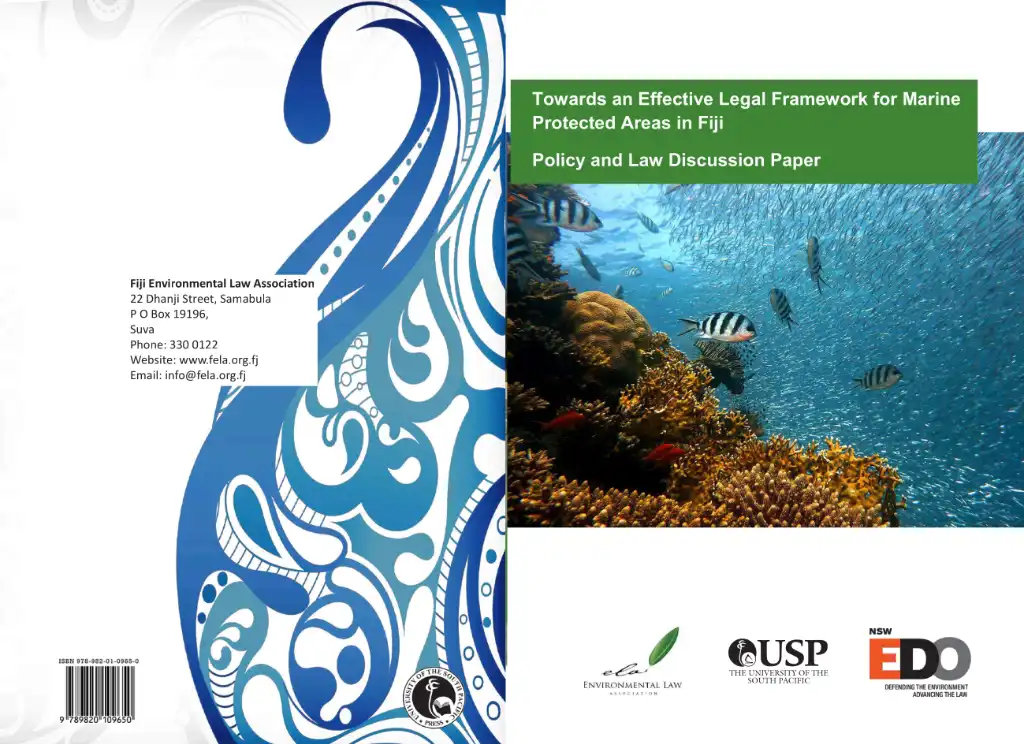
Fiji Environmental Law Association and EDO NSW. (2017). Towards an Effective Legal Framework for Marine Protected Areas in Fiji: Policy and Law Discussion Paper. The University of South Pacific Press, Suva.
Copyright
© 2017 Fiji Environmental Law Association
Reproduction of this publication for educational or other non-commercial purposes is authorised without prior written consent from the copyright owner provided that the source is fully acknowledged.
Reproduction of this publication for resale or other commercial purposes is prohibited without prior written consent from the copyright owner.
Disclaimer
While all care has been taken in the preparation of this document, FELA and EDO NSW do not accept responsibility for the accuracy or completeness of its contents.
USP Library Cataloguing-in-Publication Data
Towards an effective legal framework for marine protected areas in Fiji : policy and law discussion paper / Fiji Environmental Law Association, The University of the South Pacific and EDO NSW. — Suva, Fiji : USP Press, 2017.
64 p. ; 30 cm.
ISBN 978-982-01-0965-0
- Marine parks and reserves–Law and legislation–Fiji.
- Fishery policy–Fiji.
I. Environmental Law Association (Fiji).
II. University of the South Pacific.
III. Environmental Defender’s Office (N.S.W.).
QH91.75.F5T69 2017
333.95616099611–dc23
You must be logged in to post a comment.