
Introduction
Turtles play an important role in Pacific culture as well as that of the indigenous Fijians or iTaukei.
In certain parts of Fiji, turtles are considered totem animals or spirits. Turtles, traditional mats and whale’s teeth have cultural signi?icance and are used in some parts of Fiji in traditional ceremonies such as Chiefly weddings and Chiefly installations.
Legends of these sea creatures remain in the oral traditions to the present day.
Aside from turtles’ traditional and cultural significance, trade in marine turtle products also had significant value within the Fijian economy.
Turtle products were sold commercially from the 1800’s to the 1990’s. However, rising concern over the decline in marine turtles led to a number of significant changes in the Fisheries regulations as well as the management of the species over the years.
Ban on the harvest of marine turtles
In 1995 the Department of Fisheries issued a one-year ban on the harvest of marine turtles. This was followed by a three-year ban from May 1997 to December 2000.
In 2004 anamendment to the Fisheries Act provided for a Moratorium from February 2004 until 31st of December 2008 restricting the killing, taking, molesting or harvesting of turtles, eggs, and all sales of turtle flesh and derivatives.
The Moratorium was extended in 2010 to 31st December 2018.
“Species threatened with extinction” under the CITES 1973
Although all species of turtles are protected by the Moratorium, 5 turtle species found in Fiji waters – namely the Green, Leatherback, Loggerhead, Hawksbill and the Olive Ridley turtles- are listed as “species threatened with extinction” (Appendix 1) under the Convention on the International Trade of Endangered and Protected Species (1973) (CITES).
Under its obligations to CITES, the Fiji Government enacted the Endangered and Protected Species Act (EPS) in 2002, providing additional protection to these turtle species.
Despite the protection of turtles under CITES and the laws of Fiji, turtles, turtle eggs and their derivatives continue to be harvested, sold and consumed illegally.
One of the commonly observed reasons for this is the lack of enforcement of the Turtle Moratorium, Fisheries Act and the EPS4.
Turtle enforcement guide
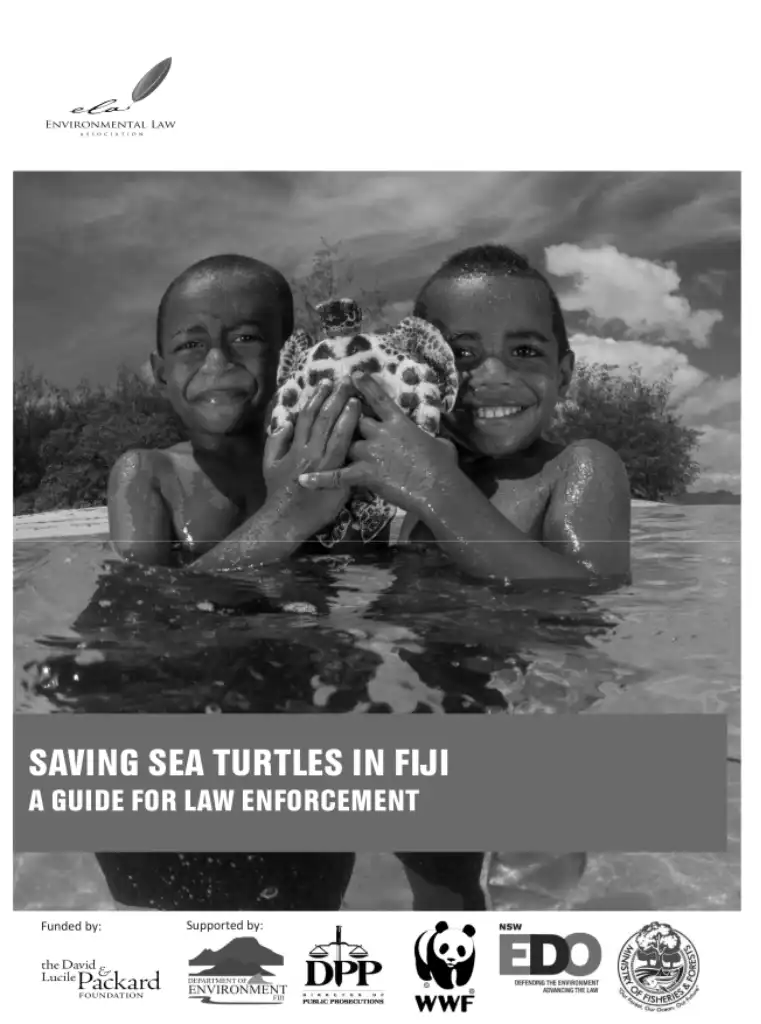
In response to the gap in enforcement, the Fiji Environmental Law Association (FELA), after consultation with partners World Wide Fund for Nature (WWF), the Department of Fisheries, the Office of the Director of Public Prosecutions (ODPP) and the Department of Environment developed this turtle enforcement guide in the hope that it will improve enforcement and help ensure the continued survival of all turtle species in Fiji waters.
The handbook provides details of relevant laws protecting turtles, offences, penalties, and guidance on investigative procedures and information on turtle species that will assist authorised enforcement officers and enforcement agencies to strengthen turtle protection in Fiji.
Acknowledgement
The (Fiji) Environmental Law Association acknowledges the following individuals and organisations for their assistance, support and input towards the develop ment of this law enforcement guide.
- Office of the Director of Public Prosecutions Suva, Fiji
- Department of Fisheries, Ministry of Fisheries & Forests
- Department of Environment, Ministry of Local Government, Housing,
- Environment, Infrastructure and Transport
- World Wide Fund for Nature
- Environmental Defenders Of ice, New South Wales
- Laitia Tamata (WWF – Suva)
- Margaret Tabunakaiwai – Vakalalabure (Department of Fisheries, Suva)
- Seini Puamau (ODPP, Suva)
- Eleni Tokaduadua (Department of Environment, Suva)
Prepared by Kiji Vukikomoala and Melania Baba for the (Fiji) Environmental Law Association.
Pictures and Diagrams: WWF – Pacifc Fiji.
Funded by the David & Lucile Packard Foundation.

You must be logged in to post a comment.